
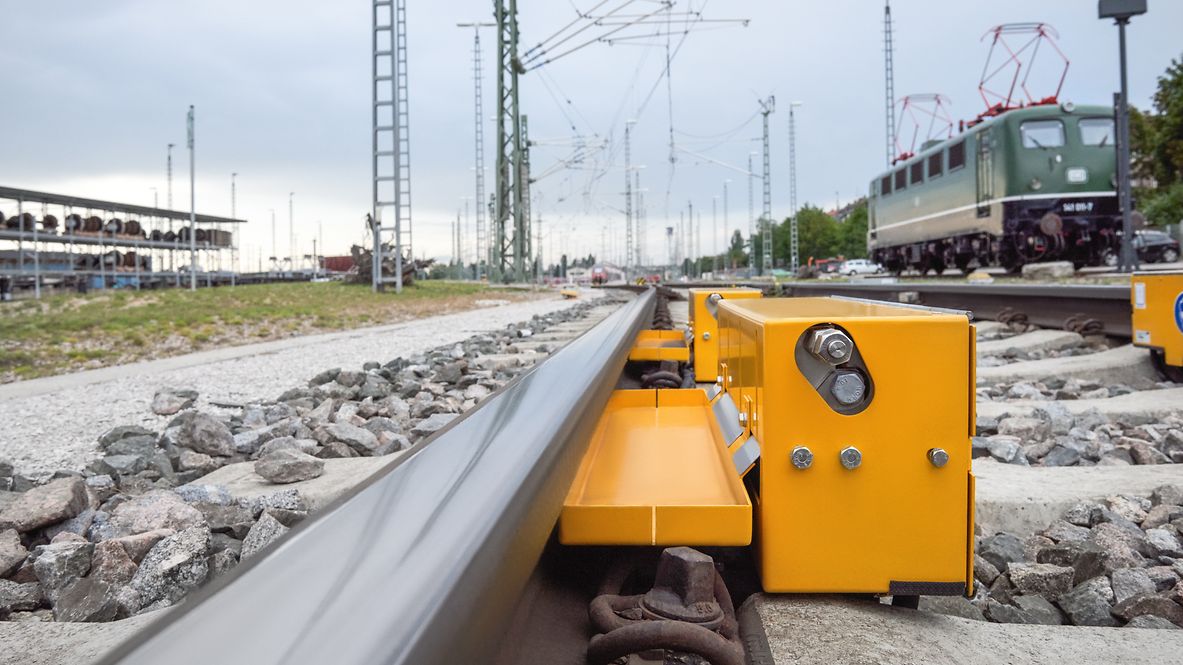

The transport of goods and passengers by rail does not happen silently. That is why Deutsche Bahn relies on various solutions to relieve residents living along railway lines. Conventional noise barriers don’t always fit into the urban landscape. In addition, space next to the tracks is not always sufficient. That is why DB is testing innovative measures to provide the most suitable solutions.
Innovative techniques for better noise protection
For example, Deutsche Bahn has tested so-called rail web dampers and deploys them at suitable locations within the rail network. The different systems are mounted at short intervals directly on both sides of the rail and consist of a steel plate sandwich element with integrated damping material. This mass-spring system reduces the rail vibrations caused by passing trains and reduces noise levels by up to three decibels.
To minimize the droning sound from bridges, Deutsche Bahn has developed a guideline featuring innovative technologies. From elastic sub-ballast mats and padded ties to bridge dampers and damping foils — the catalog of measures is diverse. It is intended to support planning offices in identifying and implementing appropriate noise protection measures. This way, noise protection can be considered from the outset — even during the renovation of older bridges.
High noise barriers are not always feasible. That’s why low-height noise barriers can also be used. Installed close to the tracks, they can reduce noise by three to five decibels. Another tool is rail lubrication systems, which grease the rails to prevent trains from squealing in curves.
Modern noise protection in tunnels
Noise protection is also a priority in tunnel construction. When trains travel at high speeds through a tunnel, they push air masses ahead of them, which can build up and, in the worst case, discharge at the tunnel exit with an audible bang. This effect occurs especially in tunnels with small cross-sections and high train speeds.
To prevent this, Deutsche Bahn equips tunnels designed for speeds of up to 300 km/h with so-called portal hoods at the tunnel entrances. These structures allow the pressure waves to escape upwards through ventilation openings, dispersing without creating a loud bang.






 Go
Go