
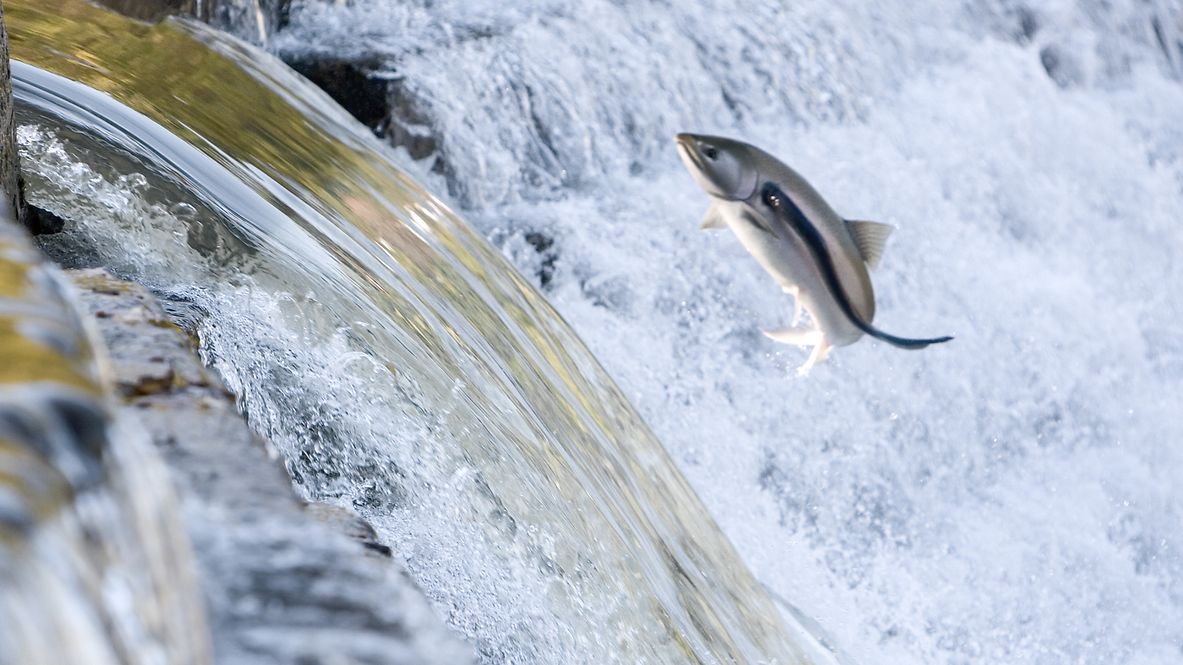
A large proportion of rivers in Germany have been straightened and expanded. As a result, communities of fish, plants, and small aquatic animals in many rivers have changed significantly. Renaturalizing river courses makes it possible to restore the original beds and banks.
When Deutsche Bahn’s construction activities affect nature, the company provides appropriate ecological compensation. As part of the expansion of the Rhine Valley Railway in Baden-Württemberg, the rivers Elz, Kinzig, Dreisam and Schutter have been revitalized. Fish species such as the Atlantic salmon, chub, bleak and dace find suitable habitats there now once again.
Fish ladders as swimming aids
Many fish species migrate upstream to their spawning grounds. Dams, weirs, or other barriers often block their way. To restore ecological connectivity and allow natural fish migrations, Deutsche Bahn has built fish ladders – including on the Schutter and the Kirnau.
On the Kirnau, in consultation with the local water authority, DB built several terraced basins from stone barriers. These basins form a type of ascent and descent system that reduces the gradient. This makes it easier for fish to overcome height differences – even species sensitive to strong currents. As a result, resident brown trout, bullheads, and brook lampreys in the Kirnau now have extensive migration and retreat opportunities. The measure is part of the renaturation project carried out during the renewal of the railway bridge over the Kirnau in Osterburken.
“Fish nursery” in the Nidda
During track construction between Frankfurt West and Friedberg, Deutsche Bahn rebuilt the Nidda Bridge in Bad Vilbel. For the construction, gravel banks had to be built up. After the works were completed, the gravel in the riverbed was reshaped to create new spawning grounds and shallow-water zones for species such as barbel, roach, bleak and dace.
In addition, DB built a so-called groyne in the river. This is a type of dam that directs the current and regulates the flow speed of the water. The resulting calm-water zones provide resting areas for fish during their spring migrations to spawning grounds.
Renaturation in Praunheim and Eschersheim
Even in the construction of the new S-Bahn tracks for the Frankfurt West–Friedberg project, interventions in nature were unavoidable. As compensation, Deutsche Bahn created habitats elsewhere. In Praunheim, for example, together with partners, an old Nidda weir was renaturalized by converting the existing fish pass into a ramp, allowing stronger water flow through the riverbed. And in Eschersheim, the bed of the Urselbach was lowered and widened over a stretch of about 400 meters to improve water flow.
 Go
Go