
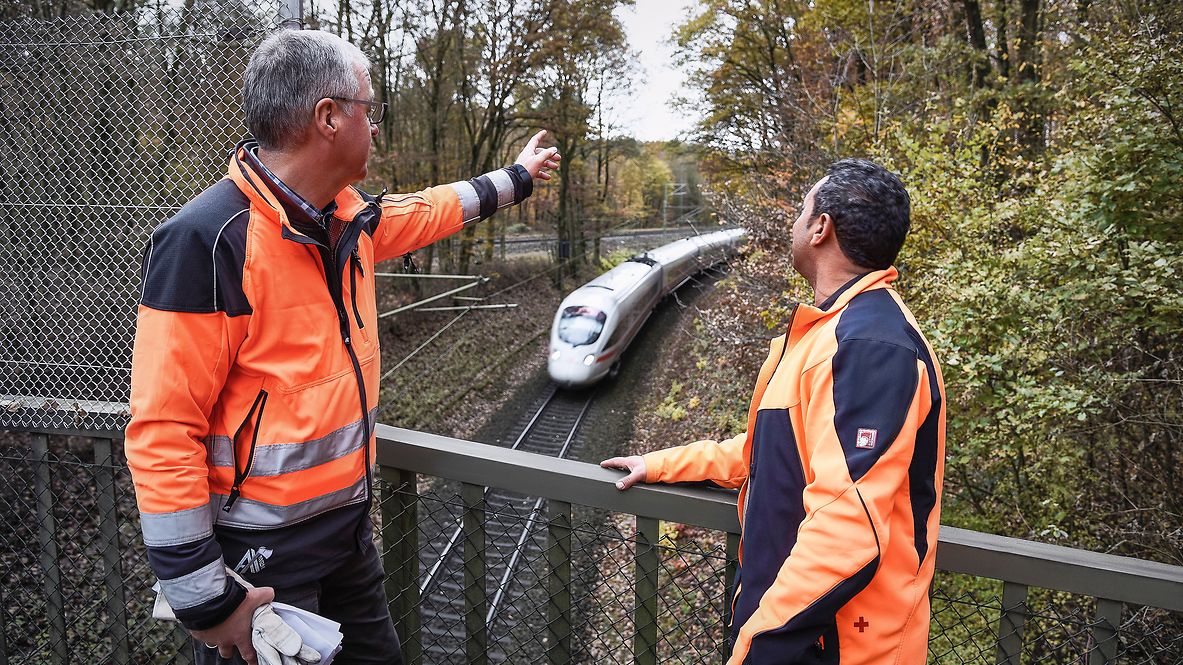
Protecting the environment and nature is a high priority for Deutsche Bahn. Therefore, DB aims to manage its land in an ecologically sustainable way. To promote biodiversity, DB has partnered with external experts to study how cutting back plants under high-voltage power lines can be optimized. The results are currently being evaluated and are planned to be tested in practice in a pilot project.
Vegetation management with state-of-the-art technology
Extreme weather events are increasing. For this reason, Deutsche Bahn is working to better monitor and maintain trees along its tracks. The inspections also use advanced technology: in collaboration with the start-up LiveEO, satellite images are analyzed to create digital vegetation maps of railway lines using artificial intelligence. This provides DB with an overview of tree density, their growth, height and distance from the tracks. This allows storm-prone trees to be identified more quickly and maintenance to be improved.
Insect protection research at stations
In the multi-year project "Insect protection at railroad stations through insect-friendly lighting" (BALIN), Deutsche Bahn AG worked with external partners to investigate how the use of alternative light sources can make a positive contribution to insect protection. To this end, DB has equipped six stations with insect-friendly lighting. Cross-window traps were used to investigate the attraction of the light sources to the insects.
The results show that LED lights with amber-colored light (1,800 Kelvin) are more suitable for protecting insects than neutral white lights (4,000 Kelvin). The reason for this is the lower blue component in amber light compared to conventional light sources. It makes lighting with a lower number of Kelvin appear warmer. In addition, nocturnal insects have a high sensitivity to brightness and are therefore more tightened by luminaires with a higher blue component. The first near-natural station facilities in Westhavelpark, Mecklenburg and in the Berlin area have already been converted to amber-colored LED lights. Further locations are being planned.
The project receives funding from the Federal Ministry for the Environment via a biodiversity program run by the Federal Agency for Nature Conservation.
 Go
Go